How to Calm a Dog Down During a Thunderstorm or Fireworks: The Complete SOS Guide
A vet-informed action plan for the next 5 minutes, tonight, and the next event — written by a dog owner who lives it every storm season with two anxious dogs.
Pawful Dreams may earn a commission when you buy through links on this page, at no extra cost to you. Please read our Affiliate Disclosure for more information.
Last updated: September 2026
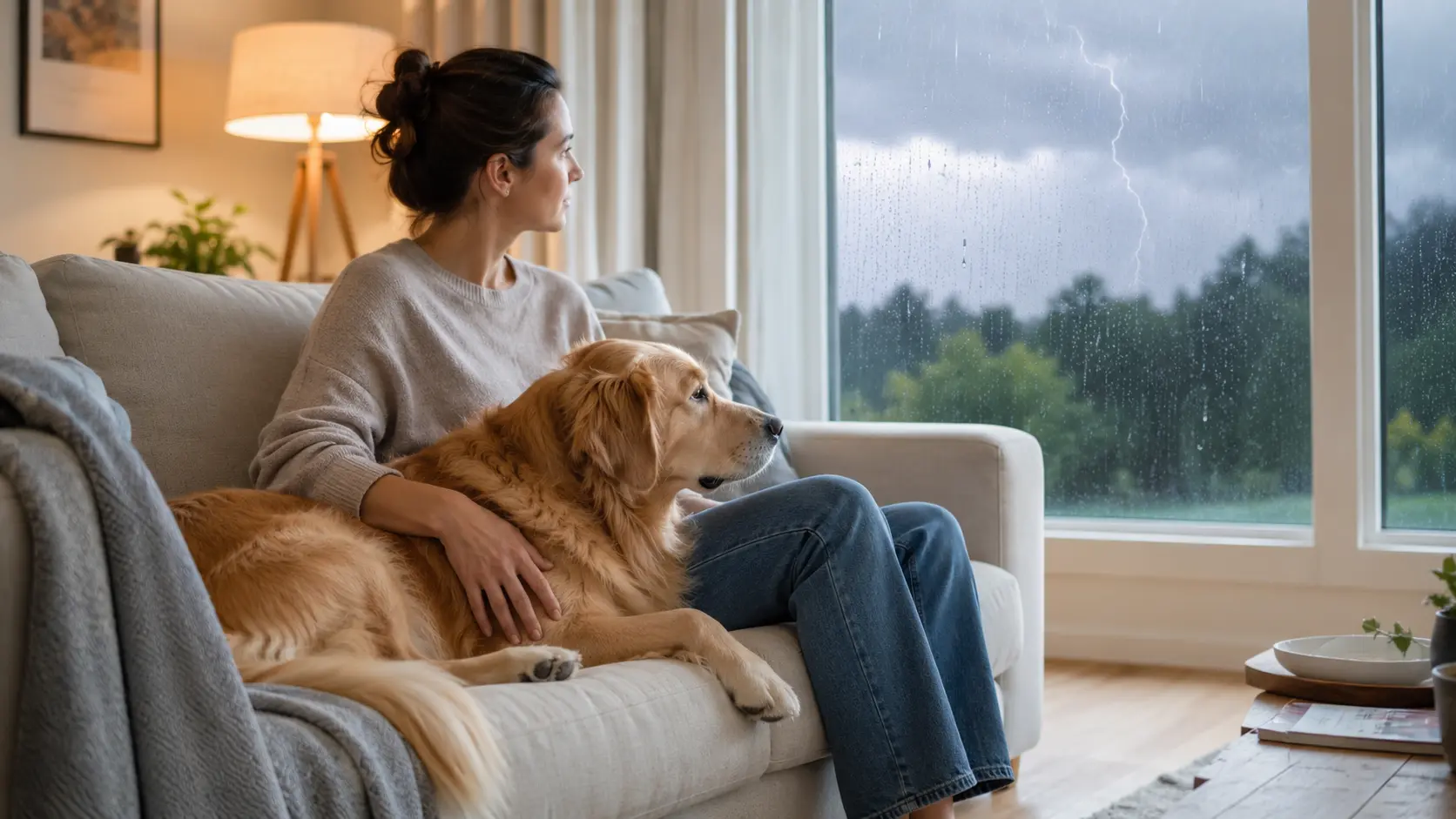
If You're Here Right Now, Mid-Panic: Start Here
Direct Answer: The fastest way to calm a storm-anxious dog mid-panic is sound masking paired with constant torso pressure before noise peaks hit. Move your dog to an interior windowless space, lower sensory stimulation, and provide calm human reassurance.
Your dog is shaking. Maybe drooling, maybe trying to climb into the bathtub or behind the couch. You don't need a training plan right now — you need something that works in the next five minutes. Here's the short version:
- Bring your dog inside, into an interior room with no windows if possible.
- Mask the sound — TV, fan, white noise, or a calming playlist, played before the peaks hit.
- Dim the lights and close the curtains to block flashes.
- Apply gentle pressure — a snug wrap like ThunderShirt Classic Calming Wrap, or just your body weight against theirs if they lean in.
- Let them hide if they want to. Do not pull them out from under furniture.
- Stay calm yourself. Dogs can respond to human tension as well as environmental noise, so calm, steady behavior may help.
- Do not punish, scold, or force them toward the door or window.
If your dog is drooling excessively, trying to escape through a door or window, or has already caused self-injury, skip to When to Call Your Vet below.
The rest of this guide covers what to do tonight, what to have on hand before the next event, and how to build a long-term plan so this gets easier — not harder — every season.
Quick Verdict
If you only do one thing before the next thunderstorm or fireworks night: prepare your dog before the noise starts, not after.
Our top pick: ThunderShirt Classic Calming Wrap — a drug-free calming vest designed to provide gentle, constant pressure around the torso. It is reusable for thunderstorms, fireworks, travel, vet visits, and other stressful situations. Check Current Price on Amazon →
Best paired with: Happy Hoodie — a soft, stretchy ear wrap that helps muffle sharp sounds and can also be useful during grooming or drying. Check Current Price on Amazon →
Comparison Table
| Product | Best For | Type | Typical Price* | Our Take |
|---|---|---|---|---|
| ThunderShirt Classic | Dogs who benefit from gentle, continuous body pressure during storms, fireworks, travel, or other stressful situations | Calming pressure wrap | Check current price | Our top pick for a reusable, drug-free calming layer that can be put on before a predictable trigger |
| Happy Hoodie | Dogs who are especially sensitive to sharp sounds or become stressed during grooming and drying | Soft, stretchy ear wrap | Check current price | A simple sound-muffling layer that can be used on its own or together with a calming wrap |
| ThunderShirt + Happy Hoodie | Dogs who respond to both body pressure and reduced sound exposure | Pressure wrap + ear wrap | Varies by size | A practical two-layer setup for owners who want to address both physical reassurance and sound sensitivity |
Prices and availability change — always confirm current details at checkout before you buy.
Know What You're Seeing: Symptom Severity Table
Not every scared dog is in the same amount of distress. This matters because it tells you whether tonight is a "wrap and wait it out" night or a "call the vet" night.
| Severity | What It Looks Like | What It Means |
|---|---|---|
| Mild | Lip-licking, yawning, mild trembling, hiding in a preferred spot | Mild stress signs may improve with a quiet safe space, sound masking, and other comfort measures. Monitor your dog, because responses vary and symptoms can escalate |
| Moderate | Pacing, heavy panting, vocalizing, clinginess, refusing food or treats | Your dog is over their comfort threshold — this is where "dog anxiety noise" masking, pressure wraps, and a dark quiet room matter most |
| Severe | Escape attempts, destructive scratching at doors/windows, self-injury, panic-level pacing that doesn't settle | Time to loop in your vet — see thresholds below |
If your dog can't take a treat from your hand, they're likely already past the point where comfort alone will bring them back down — this is a sign to start your calming protocol earlier next time, before the first distant rumble or boom.
Buying Guide: What Actually Matters in a Calming Product
What to Look For
- Match the support to the severity. Environmental changes, sound masking, and anxiety wraps may help some dogs, while moderate or severe noise aversion may also require medication prescribed by a veterinarian. The right plan depends on the dog’s symptoms, health, and response to previous approaches.
Sources: Cornell Richard P. Riney Canine Health Center: Sound Sensitivities; VCA Animal Hospitals: Managing Fear of Storms and Fireworks in Dogs.
- Reusable across triggers. ThunderShirt can be used for thunderstorms, fireworks, travel, vet visits, and other stressful situations. Happy Hoodie can also be useful during grooming and drying when sound sensitivity is part of the problem.
- Preparation matters. Introduce both products during a calm moment before you expect your dog to wear them during a storm, fireworks, grooming, or another stressful event.
- Fit matters. A pressure wrap or ear wrap should be snug enough to stay in place without restricting breathing, movement, or comfort. Follow the manufacturer’s size guide and supervise initial use.
Best For X
- Best for gentle, full-body pressure: ThunderShirt
- Best for muffling sharp sounds around the ears: Happy Hoodie
- Best for grooming or drying noise: Happy Hoodie
- Best for dogs who benefit from both approaches: Use both products together, provided your dog is comfortable wearing them
How to Calm a Dog Down During a Thunderstorm: The 4-Week-Before Plan
If you know storm season or the 4th of July is coming, don't wait for the night of. Vets and behaviorists consistently point to the same sequence:
3–4 weeks before:
- Introduce the Happy Hoodie during a calm moment and keep the first sessions short, positive, and supervised.
- Introduce your dog to the ThunderShirt in a calm moment so it is associated with something familiar and positive, not only with panic.
1 week before:
- Identify your dog's safe space — a crate, a closet, under a bed — and make sure they can access it freely.
- Test your sound-masking setup (fan, white noise, or a calming playlist) at a normal volume.
Night of:
- Follow the SOS steps at the top of this page.
- Stay home if you can. A dog who is already anxious and then left alone during fireworks is at the highest risk of escape attempts.
After the event:
- Don't force your dog out of hiding once it's over — let them come out on their own timeline.
- Note what worked and what didn't. Every dog's threshold is a little different.
What Not to Do
- Don't punish fear-driven behavior. Barking, hiding, or even destructive behavior during a storm is not disobedience — it's panic.
- Don't force exposure. Dragging a hiding dog out to "get used to it" makes the fear worse, not better.
- Don't crate a dog mid-panic unless the crate is already their relaxed safe space. A crate that isn't already a comfort zone can turn into another trigger.
- Don't wait until the peak of the storm to act. Every product on this page works best when it's in place before the noise starts, not after your dog is already over threshold.
Individual Reviews
ThunderShirt Classic Calming Wrap
Verdict: A reusable, drug-free calming vest designed to apply gentle, constant pressure around the torso. It is a practical option for owners who want a wearable calming layer ready before thunderstorms, fireworks, travel, vet visits, or other predictable stressors.
Pros:
- Provides gentle, continuous pressure without medication
- Reusable across several common anxiety triggers
- Available in multiple sizes
Cons:
- Not every dog responds to pressure in the same way
- Correct sizing and gradual introduction are important
Who it's for: Dogs who settle more easily with close body contact or gentle pressure and owners who want a reusable calming option.
Happy Hoodie
Verdict: A soft, stretchy ear wrap designed to sit snugly around a dog’s head and help muffle sharp or distracting sounds. It can be useful during thunderstorms, fireworks, grooming, or drying, especially for dogs that react strongly to noise around their ears.
Pros:
- Soft, stretchy design
- Helps reduce direct exposure to sharp sounds
- Can also be used during grooming and drying
Cons:
- Some dogs need gradual introduction before they accept wearing it
- It should not be fitted so tightly that it affects comfort or breathing
Who it's for: Noise-sensitive dogs and owners who want a simple, wearable sound-muffling layer.
Also Consider / Who Should Skip This
Also consider: ThunderShirt and Happy Hoodie are supportive tools, not complete treatment plans. If your dog shows severe panic, self-injury, escape attempts, complete refusal to eat, or distress that does not settle after the trigger has ended, contact your veterinarian.
Who should skip the DIY route entirely: Dogs with a history of injuring themselves during panic episodes, or dogs whose fear has escalated significantly since last season. That pattern is common and doesn't mean you did anything wrong — but it does mean this page is a supplement to veterinary care, not a replacement for it.
When to Call Your Vet: Emergency Thresholds
Call your vet — same day if possible — if you see any of the following:
- Your dog is injuring themselves trying to escape (broken teeth, bleeding paws, torn nails)
- Panting and pacing that doesn't ease at all even hours after the noise has stopped
- Complete refusal of food or water for more than 24 hours
- Your dog has ever bolted and gone missing during a previous event
- Signs are clearly escalating year over year rather than improving with the steps above
None of the products on this page are a substitute for veterinary care in a severe case — they're the first line, not the last one.
Why Trust This Guide
This page was built from veterinary and behavioral sources (Cornell Riney Canine Health Center, VCA Hospitals, PetMD, ASPCA) combined with direct research into the most common real owner questions on Reddit, Quora, and veterinary Q&A boards during actual fireworks and storm events. We update it every storm and fireworks season to reflect current product options and pricing. We are not vets — for anything beyond general guidance, talk to yours.
Frequently Asked Questions
My dog is shaking and won't stop during fireworks — what do I do right now?
Move them inside to an interior room, mask the sound with a fan, TV, or calming playlist, dim the lights, and let them hide if they want to. A pressure wrap like ThunderShirt can help in the moment, but the single biggest factor is staying calm yourself — dogs pick up on our stress as much as the noise outside. This isn't the moment for a training plan; it's the moment for damage control, and that's completely fine.
My dog ran out the door during fireworks — how do I get a scared dog back home?
If your dog is still in sight, do not chase or corner them. Move slowly, turn slightly away, crouch or sit, and try to lure them with food or another familiar reward. Avoid repeatedly shouting their name, which may cause a frightened dog to keep running. If your dog is no longer visible, contact local shelters, animal control, veterinary clinics, and lost-pet recovery services as quickly as possible. After your dog is safely home, review doors, gates, identification tags, and microchip details before the next fireworks event.
Can I give my dog Benadryl, Trazodone, or Xanax for fireworks tonight?
This is a question for your veterinarian, even if you already have one of these medications at home. The correct medication, dose, and timing depend on your dog’s health and the specific product. Sileo and Tessie are FDA-approved prescription treatments for noise aversion in dogs, and Tessie is also approved for separation anxiety. Never give your dog human medication or change a prescribed dose without veterinary guidance. If you cannot reach your regular veterinarian and your dog is in severe distress, contact an emergency veterinary service.
Source: FDA approval information for Tessie and canine noise aversion treatments.
My dog is panting, drooling, and pacing during a thunderstorm — is this dangerous?
Panting, drooling, and pacing can occur with noise-driven stress, but they can also have medical causes. If the signs are new, severe, persistent, or accompanied by breathing difficulty, weakness, collapse, disorientation, or self-injury, contact a veterinarian or emergency clinic. That said, if panting doesn't ease at all for hours after the storm has passed, or your dog seems disoriented beyond what you'd expect from fear, that's a different picture — trust your instincts and call your vet if something feels off.
Should I comfort my anxious dog, or will I make it worse?
Comfort your dog. Current veterinary guidance — not the older "don't reinforce fear" advice you may have heard — is clear that comforting a frightened dog doesn't reinforce the fear, the same way comforting a scared child doesn't teach them to be more scared. What you want to avoid isn't comfort; it's forcing exposure or dragging your dog toward the thing that's scaring them. Sitting with them, using a calm voice, and letting them lean into you is not spoiling them — it's what a scared animal needs from you in that moment.